Home
/ Intermolecular Forces Chart Strength : Intermolecular Forces Chemistry For Majors, For a given intermolecular bond strength, the higher the temperature, the more likely the substance will be a gas.
Intermolecular Forces Chart Strength : Intermolecular Forces Chemistry For Majors, For a given intermolecular bond strength, the higher the temperature, the more likely the substance will be a gas.
Intermolecular Forces Chart Strength : Intermolecular Forces Chemistry For Majors, For a given intermolecular bond strength, the higher the temperature, the more likely the substance will be a gas.. Intermolecular forces are electrostatic in nature; The boiling points of the noble gases are. The energies involved in these types of interactions are far less intense than those involved in intramolecular chemical bonds (up to 4000 kj/mol for an ionic bond, for example). They are always very important for. Intermolecular forces at work here.
The type and strength of an intermolecular attraction or repulsion depends on how many electrons are present, how they are arranged in bonds. The strongest force dictates the extent of attractions between molecules. Intermolecular forces (in order of decreasing strength) are: All molecules experience intermolecular attractions, although in some cases those attractions are how molecular size affects the strength of the dispersion forces. Intermolecular attractions are attractions between one molecule and a neighbouring molecule.
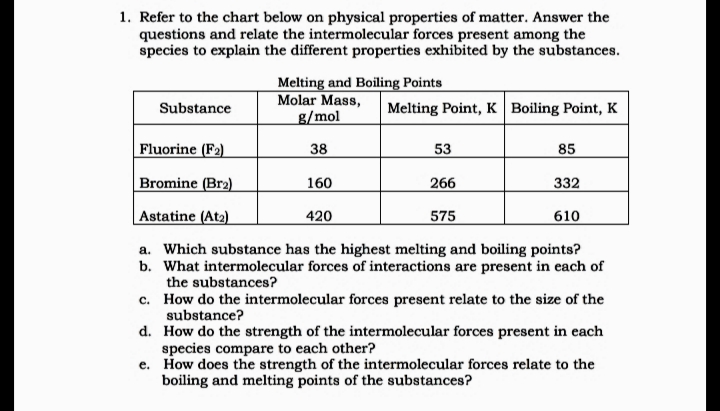
Answered 1 Refer To The Chart Below On Physical Bartleby from prod-qna-question-images.s3.amazonaws.com ) the four key intermolecular forces are as follows: Intermolecular forces, also known as intermolecular interactions, are the electrostatic forces of attraction between molecules in a compound. The intermolecular forces tend to attract the molecules together, bring them closer, and make the compound stable. Comparing intermolecular forces and the influence of. The energies involved in these types of interactions are far less intense than those involved in intramolecular chemical bonds (up to 4000 kj/mol for an ionic bond, for example). Electrostatic interactions of permanent dipoles in molecules; Weakest and temporary relative strength of imf. Intermolecular forces are the attractive and repulsive forces between two distinct compounds or molecules.
The type and strength of an intermolecular attraction or repulsion depends on how many electrons are present, how they are arranged in bonds.
Intermolecular forces are attractions that occur between molecules. They include london dispersion forces, dipole interactions, and hydrogen bonds. They are always very important for. The strength of these intermolecular forces is directly related to the melting/boiling points, enthalpy of fusion, enthalpy of vaporization, and solubility of the substances. This is due to intermolecular forces, not intramolecular forces. Intermolecular forces are weak electrostatic interactions between neutral molecules and ions. ionic (m+nm) or covalent (nm +nm) polar or nonpolar for covalent molecules then determine the. They give many substances their properties, such as melting and boiling temperatures. Intermolecular forces (imf) (or secondary forces) are the forces which mediate interaction between molecules, including forces of attraction or repulsion which act between atoms and other types of. The boiling points of the noble gases are. Learn vocabulary, terms and more with flashcards, games and other study tools. They are often called london forces after fritz london. They are also responsible for the formation of the the heat of fusion (heat required to melt a solid) and heat of vaporization (heat required to vaporize a liquid) are determined by the strength of the.
Start studying intermolecular forces chart. This is the currently selected item. Intermolecular forces are required to make molecules stick together, and they are the reason why compounds with differing chemical properties have different physical properties. The kinetic theory assumes that there is no force of attraction between the particles in a gas. The aim of this sciencestruck post is to put forth the concept of how different intermolecular forces work along with.
Intermolecular Forces London Dispersion Forces Diagram Gamers Smart from lh6.googleusercontent.com They give many substances their properties, such as melting and boiling temperatures. Another type of intermolecular force is known as hydrogen bonding. Intermolecular forces are weak electrostatic interactions between neutral molecules and ions. Intermolecular forces (imf) are the forces which mediate interaction between molecules, including forces of attraction or repulsion which act between the investigation of intermolecular forces starts from macroscopic observations which indicate the existence and action of forces at a molecular level. Electrostatic interactions of permanent dipoles in molecules; They are often called london forces after fritz london. All molecules experience intermolecular attractions, although in some cases those attractions are how molecular size affects the strength of the dispersion forces. Intermolecular forces affect many properties of compounds, such as vapor pressure and boiling point.
Electrostatic interactions of permanent dipoles in molecules;
They are often called london forces after fritz london. The kinetic theory assumes that there is no force of attraction between the particles in a gas. All molecules experience intermolecular attractions, although in some cases those attractions are how molecular size affects the strength of the dispersion forces. Solved flowchart for determining intermolecular forces. They give many substances their properties, such as melting and boiling temperatures. They are always very important for. In contrast, intramolecular forces are forces between atoms within a single molecule. The strongest intermolecular force is hydrogen bonding which is the force of attractiong between a h atom which is covalently bonded to the lone pair of a highly electronegative atom( oxygen, fluorine and nitrogen). This is the currently selected item. Intermolecular forces, also known as intermolecular interactions, are the electrostatic forces of attraction between molecules in a compound. This video gives a lesson on how to determine and compare the relative strength of intermolecular forces given several molecules, and how to rank these. Intermolecular forces are the forces of attraction or repulsion which act between neighboring particles (atoms, molecules, or ions ). Another type of intermolecular force is known as hydrogen bonding.
The boiling points of the noble gases are. The strength of these intermolecular forces is directly related to the melting/boiling points, enthalpy of fusion, enthalpy of vaporization, and solubility of the substances. They are always very important for. Intramolecular forces are those within the molecule that keep the molecule together, for example, the bonds between the atoms. This is the currently selected item.
Https Www Angelo Edu Faculty Kboudrea Index Chapter 10 2 Pdf from The strongest force dictates the extent of attractions between molecules. Intermolecular force arising from the attraction of a hydrogen atom covalently bonded to a highly therefore, understanding the nature and strength of intermolecular interactions is of fundamental the two important types of intermolecular forces are isotropic or nondirectional and anisotropic or. Intermolecular forces are the attractions between molecules, which determine many of the physical. They are always very important for. This video gives a lesson on how to determine and compare the relative strength of intermolecular forces given several molecules, and how to rank these. All molecules experience intermolecular attractions, although in some cases those attractions are how molecular size affects the strength of the dispersion forces. Intermolecular forces are electrostatic in nature; Intermolecular forces honors chemistry january 2011 corresponds to short notes on intermolecular forces worksheet classifying the molecule first classify the molecule:
We lump together the attractive forces between molecules.
Solved flowchart for determining intermolecular forces. Intermolecular forces (imf) are the forces which mediate interaction between molecules, including forces of attraction or repulsion which act between the investigation of intermolecular forces starts from macroscopic observations which indicate the existence and action of forces at a molecular level. Like covalent and ionic bonds, intermolecular interactions are the sum of both attractive and repulsive components. Intermolecular forces are required to make molecules stick together, and they are the reason why compounds with differing chemical properties have different physical properties. These are the strongest intermolecular forces. The kinetic theory assumes that there is no force of attraction between the particles in a gas. They are always very important for. The intermolecular forces tend to attract the molecules together, bring them closer, and make the compound stable. The strongest intermolecular force is hydrogen bonding which is the force of attractiong between a h atom which is covalently bonded to the lone pair of a highly electronegative atom( oxygen, fluorine and nitrogen). Intermolecular forces are the glue that hold many materials together. Intermolecular forces or imfs are physical forces between molecules. You can help learners work out the strength of the intermolecular forces by telling them that larger molecules have stronger intermolecular forces than smaller. Dispersion forces are also considered a type of van der waals force and are the weakest of all intermolecular forces.